DIGITAL OR OFFSET?
Digital printing. The expression no longer sounds new today, although its true expansion is only now expected to begin in earnest. While the distribution of information through electronic devices and platforms has clearly conquered the world through exponential growth, demand for printed publications in marketing and advertising remains unbroken.
The main reason may be our attraction to a physical product and our need to hold and touch it; advertisers, meanwhile, have learned that the more types of stimulus a person encounters, the better they remember the associated subject.
What has certainly changed—and encourages this new generation of print production to develop further—is the reduction in print quantities. Compared with traditional printing processes, digital printing offers indisputable advantages: favourable production prices even for very small quantities, much faster fulfilment and flexible, unrestricted reprinting.
Offset printing, which is still an alternative to more modern digital technology, demonstrates its true competitiveness mainly in large quantities. It is understandable, therefore, that in fields where several thousand copies of a printed product are still justified, digital production may not be an option—unless speed is the priority. Our printing company in Budapest encounters many such cases.
Another important consideration is that although the unit cost of high-volume material may be lower, its content cannot be updated until the whole quantity has been used. This is a major disadvantage where product ranges, price lists and other information are continually updated in response to the market environment.
It is also worth saying a few words about the quality advantages of modern printing.
At first, resolution, print quality and the precision of colour registration—the basic conditions of quality production—did not come close to the standard of offset technology. Over the years, however, manufacturers of digital printing presses incorporated more and more innovations and insight-led developments into their equipment. Today, the flawless quality of digitally produced prints convinces customers who need small quantities or variable data.
Every business today may need marketing materials produced using digital printing technology. Its principal advantage is that perfect-quality marketing publications can be produced quickly, in small quantities and at a favourable price. Digitally printed marketing tools may include a corporate folder, prospectus or brochure, and product labels.
The printed marketing tools a business uses say a great deal about it. Consider how much more appealing it is to hand over a document in a folder that matches the corporate identity and also contains a business card in a holder designed specifically for it. The overall effect can be enhanced with custom corporate notepads, wire-bound notebooks or even a catalogue presenting our products and services.
Thanks to our many years of experience in digital printing, you can confidently contact us whatever printed product you have imagined for your business. Whether you have a specific concept or only the outline of an idea, our colleagues are ready to assist you—from selecting the right materials and dimensions, through graphic design and production, to holding the completed printed marketing tool in your hands.
Share your ideas with us and allow us to help bring them to life!
Proof printing and prototype production
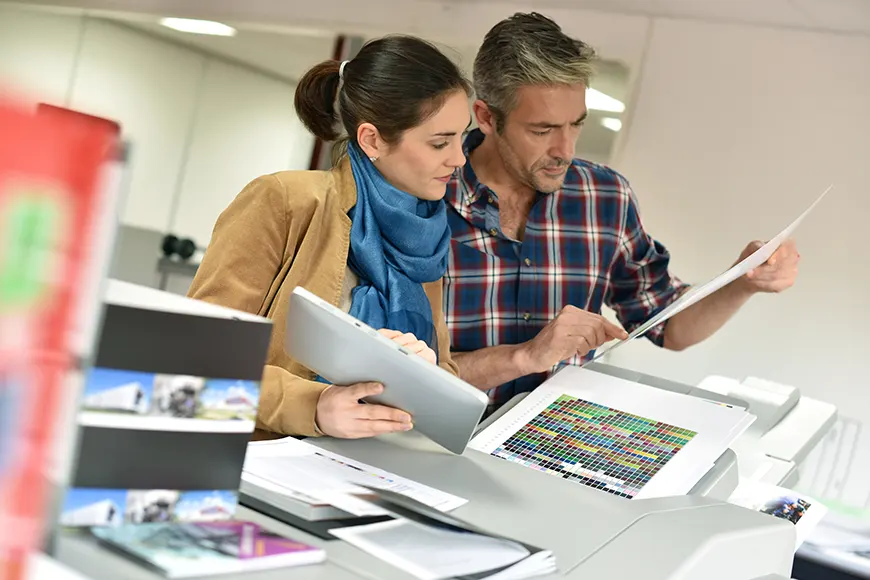
The colours produced by graphic design work on a monitor are not always reflected in the physical print. The main reason is incorrect system calibration, together with several other technical pitfalls that experienced designers already understand. But what can beginners do?
There is no reason to worry, because a small gap in technical knowledge need not prevent correct colours from being produced. That is why we offer a free proof-printing service.
A process that was complicated in the past has become considerably simpler thanks to professional digital equipment. In practical terms, none of our customers needs to worry about the printing quality or colour accuracy of material prepared by their designer, because on request we provide a free proof before the full print run.
The sample, which can also be regarded as a prototype, corresponds in every respect to the appearance that will be produced during printing. If you are uncertain about the graphic material or request printing on a paper different from that used for previous orders, our proof service provides a reliable opportunity for inspection.
We especially recommend producing a proof before manufacturing work that must comply with a fixed visual-identity specification, because numerous technical factors influence the final result. This can prevent a possible departure from the familiar colour palette. Correct colour management is, of course, also far from a minor consideration.
We also recommend the service if you are working with a new designer or using a workstation that has not been system-calibrated. Ordering a proof is simple: send a sample to our customer service team, and once the proof is ready we will notify you how it can be viewed.
If you commission us to undertake the graphic design, we always produce a proof, since achieving a flawless result is important to us as well. Naturally, the opportunity to view the print is also available in this case upon separate request.
For more complex printed products, such as corporate calendars, you can even order a complete, specific prototype. Physically, this is identical to the product that will ultimately be manufactured, allowing the preparation to be refined even further.