REFINED AND DISTINCTIVE.
WHAT SETS YOU APART.
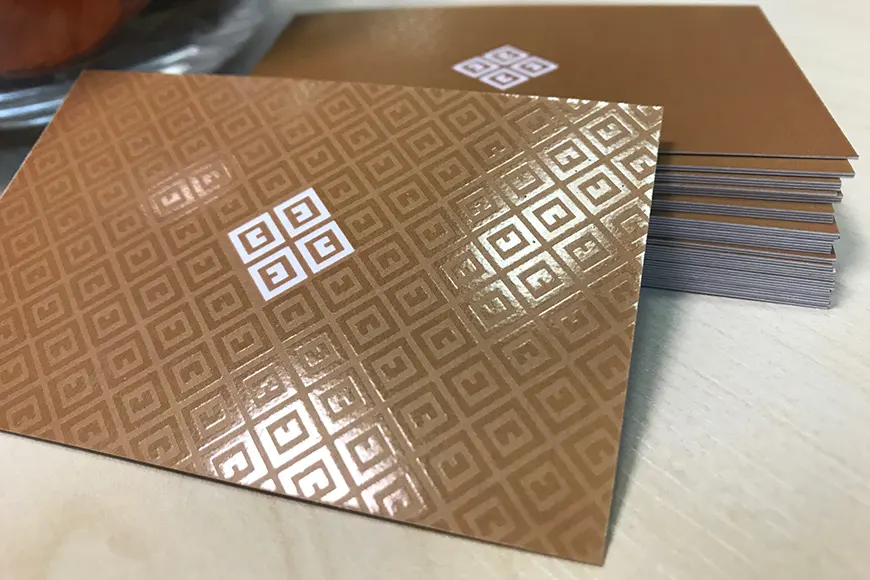
The collective term describes processes that give printed materials more individual and appealing qualities than average. Their general purpose is to strengthen the company image and distinguish it from competitors.
Ordering printed products with surface finishing effectively gives them a degree of exclusivity—in other words, added value.
Film lamination
Film lamination is one of the most affordable and most frequently requested surface-finishing processes. It should not be confused with pouch lamination: instead of giving the printed piece a plastic-welded border, a micron-thick gloss or matt coating is fixed across its entire surface with a special heat-activated adhesive bond.
The film makes the printed product more attractive both to the touch and to the eye, while also providing resistance to mechanical effects.
It is a common enhancement for business cards, brochure covers and corporate folders.
We especially recommend film lamination for heavily saturated printing, such as solid areas with complete coverage. In addition to the benefits and protective functions mentioned above, it protects the ink layer and prevents visible fingerprints from adhering to the surface.
Spot UV varnish
This process highlights particular parts of a printed publication—usually visual elements, logos or drawings. The highlighting appears as a shine: it creates a glossier, more reflective surface in the shape specified by the design. The varnish hardens under UV light on a surface that is generally matt-laminated. It enables us to create particularly striking publications that add considerably to the product's aesthetic value.
Preparing the varnish artwork requires separate graphic design and specialist expertise, with which we can naturally assist.
Numbering and variable-data printing
Personalisation does not necessarily mean production addressed to a specific person; in a broader sense, it means customisation. Its purpose is to build the particular customer's commitment or make their activity administratively measurable for marketing.
Almost everyone has certainly encountered this method, although they may not have consciously realised that they were taking part in a campaign addressed to them personally or assessing their activity.
Customisation and numbering
From an administrative perspective, the most widespread method is numbering, in which every printed item receives a unique identification code. Its importance appears in many fields, from maintaining records to measuring consumer habits. A serial number can also assign a priority to a customer or purchased product.
It is generally used for direct-mail letters, although innovative marketing has developed many other ideas to ensure the success of targeted information.
Customer coupons, membership cards, brochures and invitations can all be personalised and provided with a unique identifier. With a skilful strategy, the sales objectives will certainly follow.
But how is it produced?
Technically, we know numerous customisation solutions—film lamination, UV varnishing, numbering and others—but our customers are responsible for providing the specific content. This means that the list of names, addresses or other data, such as serial numbers, must be supplied to the printing company in an Excel or text file. Our colleagues can work with clearly defined data, and these two components together ensure that the required customised printed products are produced as intended.
It is also important to mention certain physical-processing methods as further possibilities, such as perforation. This allows paper sections to be detached so that the customer can retain one part—for example, the other half of an admission ticket.
Naturally, customisation processes can be combined to suit the defined marketing objectives.
Defining forms and custom shapes
Printed marketing and advertising materials generally sell a company's services and products through two important factors. One is professionally prepared content decorated with visual elements; the other is the physical presentation of that content adapted to the target audience—in other words, the publication size designed for its intended use.
How can custom forms increase the effectiveness of visual presentation and an excellent-sounding promotion even further? With die cutting.
Die cutting means moving beyond straight cuts towards flexible and curved forms, a distinctive exterior and practicality. As a simple example, consider a promotional flyer for a shop selling batteries. Imagine one promotional flyer cut into a square, then imagine another shaped like a battery, complete with its projections and terminals—or perhaps simply with a lightning-bolt cut-out in the centre. There is probably no question which publication will be more appealing to the target consumer and more likely to encourage them to read it.
Naturally, the same is true of numerous custom campaigns launched by baby shops, butcher's shops, computer retailers—or anyone else. A custom shape is an extra feature that distinguishes the particular advertising or information product from competitors' publications. It is more than a flyer and more than a promotional brochure: it is a marketing tool that attracts attention and interest.
Die-cutting technology combines old and new methods. Today, the graphic designer sends the imagined shape to the toolmaker as a digital file. Based on the shape, the toolmaker produces a cutting die—an arrangement of sharp blades formed into the required outline, including curves. The blades cut the paper or board according to the shape required by the graphic design.
Other elements can also be fitted to the cutting tool alongside the blades. A creasing rule, for example, compresses the paper fibres so that a fold can be made along it without cracking, as required for corporate folders or packaging boxes.
A perforating rule is useful for publications where a promotional coupon or reply slip must be detached from a catalogue or flyer.
There is also a kiss-cutting blade, used mainly on self-adhesive materials to prepare the print medium for removal, making it easier, for example, to apply a sticker to its surface. Tool blades are made of flexible, durable steel that resists rust and wear and can withstand tens of thousands of impressions. An impression is the operation in which the die-cutting machine presses the paper against the tool with great force, cutting out the shape defined by that tool.
This brings us to the production cost mentioned above. For a small quantity, the cost of the tool may exceed the printing cost of the finished product. It is therefore worth planning the quantity of a custom publication for an optimum production run and organising its distribution effectively.
When requesting a production quotation, it is worth asking the supplier for advice about quantity. The tool cost is fixed, so once spread across a sufficiently large number of copies it may become almost negligible. It is also important to know that the tool represents a one-time cost but can produce tens of thousands of finished shapes. From that perspective, the costs can be analysed very differently.
Many more pages could be written about the technology, but that is not the purpose of this article. When publishing it, we considered it far more important to introduce a solution that many have already used and that gives future marketing or advertising materials a distinctive form.