PAPER SELECTION GUIDE
Some people know exactly which type of paper they want for the printed product before design work even begins, but let us admit that this is the less common situation. Customers often face the question of the most appropriate material only after the visual design has been completed. This short guide is intended to provide a little help with that decision.
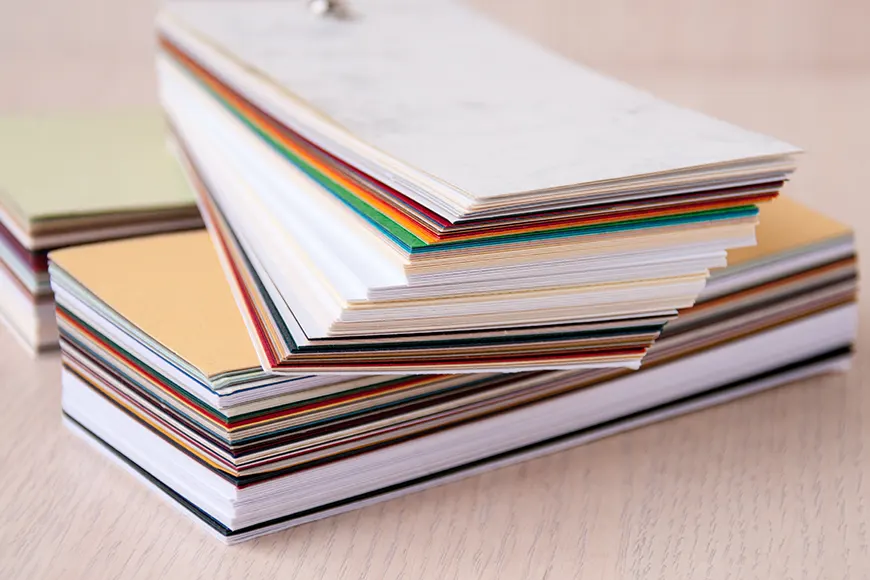
The surface and whiteness of all the standard papers we use are ideally suited to reproducing the colour printed on them, while graphic elements appear sharp and free from distortion.
Paper for business cards
Server Line produces business cards on excellent-quality 300 and 350 gsm white card to guarantee a high-quality, durable result. Finishing processes such as matt or gloss film lamination or UV varnish can make the business card distinctive or even more robust.
If you would like your business card on a more creative, elegant base paper, we can recommend two types of subtly ribbed creative card in natural white, a slightly yellowish shade or brilliant white. It is best printed without a background colour and preferably with one or two colours. Because of its ribbed surface, this business-card material cannot be film-laminated.
Paper for flyers
When producing a flyer, the intended use and the message to be communicated can determine the paper selection. As a starting point, we recommend 130 gsm matt or gloss coated paper. If you want a more durable or rigid flyer, you need to choose a heavier paper.
Film lamination is not typical for flyers, but if this type of finish is required, it must be taken into account that film can only be applied to paper above 170 gsm. Whether the printed piece should use a matt or gloss base paper is a matter of taste and design.
Paper for prospectuses and brochures
For a prospectus or brochure, the material can vary greatly according to the page count, page dimensions, folding or binding method and the nature of its later use. For unbound, folded leaflets, the considerations described for flyers provide a good starting point.
For a multi-page brochure, film lamination is always recommended for the outer pages, for which a cover of at least 200 gsm is an appropriate choice. For the inner pages—if the page count is not too high—the same weight as the cover can be retained, but they are generally produced on thinner paper according to the required durability. Care must be taken, however, because paper that is too thick is more difficult to keep folded and springs open more easily.
Material for folders
When discussing folder production, there are two types: for smaller quantities we make folders with an applied document pocket, while larger orders use a die-cut folder. Applied folders are always made from high-quality 300 gsm card. The card folders can receive a matt or gloss film coating as a finish. Die-cut folders are produced from 350 gsm card and may likewise receive matt or gloss film lamination. Both versions can optionally be enhanced with UV varnish.
Material for posters
Up to A3, posters are normally produced on 130 gsm coated paper. Larger sizes are printed on blueback poster paper or photo paper. Film or pouch lamination can also be used as an additional finish for posters.
Material for stickers
For stickers, the first question is whether the finished product will be used indoors or outdoors and whether it will be attached from the outside or inside—for example, to a shop window. A UV-resistant sticker or label can be selected accordingly. The next question is whether the sticker also needs to be waterproof. In most cases, the options then include front- or back-kiss-cut sheets, sheets left intact, individually cut pieces or even contour-cut shapes.
If you are uncertain, you can also ask about recommended papers through our printing quotation form.