ESSENTIAL PRINTING TERMS
Every day, our production-preparation department receives and inspects print-ready artwork supplied by our customers. On many occasions we must request corrections or have our colleagues revise the designs.
The most common artwork-submission errors include problems with bleed, margins and colour space, as well as image-resolution issues. We therefore explain several important terms below to assist the design process.
Printing specifications
1+0: Printing in one colour on one side (black in digital printing).
1+1: Printing in one colour on both sides (black in digital printing).
4+0: Full-colour printing on one side.
4+4: Full-colour printing on both sides.
5+0 or 5+5: The fifth colour indicates a spot colour, such as gold or silver.
Colour spaces
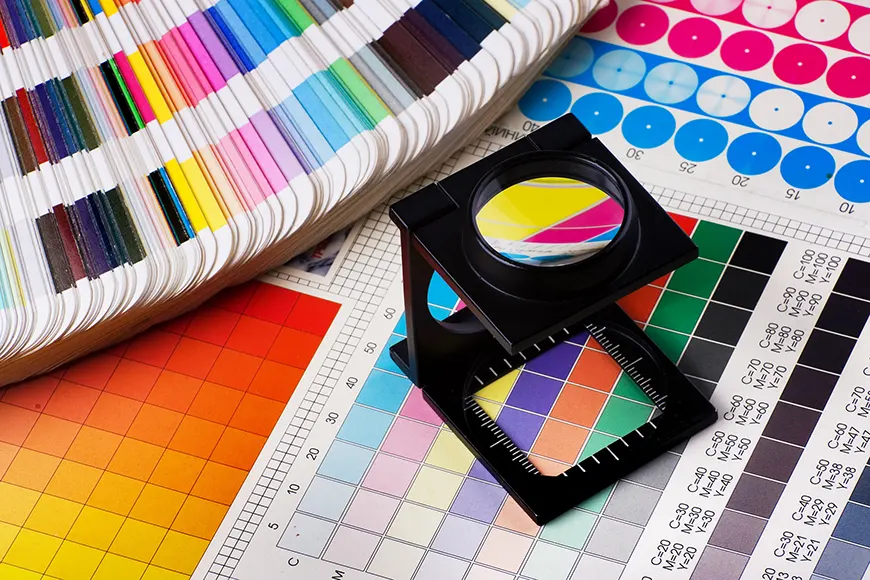
CMYK is used for print production, while RGB colours are suitable for digital screens. The two colour-mixing systems do not produce exactly the same colours, only approximations. The colours in the submitted design will therefore not appear precisely on your monitor. To check colour accuracy, we recommend our free proof-printing service.
CMYK: The colour-mixing method used in printing. Its basic colours are Cyan, Magenta, Yellow and Key (black). It is a subtractive colour-mixing method: the four basic colours are placed closely together as tiny dots to create the final image.
RGB: An additive colour-mixing method in which three basic colours emit light from a display in varying proportions to create all other colours. The RGB primary colours are Red, Green and Blue.
Print preparation
Bleed
If the artwork to be printed reaches the edge of the sheet—including a solid background colour—it must be designed so that these elements extend beyond the actual trimmed size. Without bleed, a white strip a few millimetres wide might appear along the edges after trimming, or the same amount could be lost from an important visual element. A minimum bleed of 3–5 mm on every side is generally accepted in the printing industry.
Crop marks
These are essential for trimming printed material to size, as they indicate exactly where the cutting machine must cut. On request, our graphic designers will set the crop marks for the publication to suit our printing presses.
Trimmed size, finished size
The actual dimensions of the printed product after completion.
Vector graphics and vector formats
Graphics composed of points, straight lines and curves. They can be enlarged or reduced without loss of quality, so printing them will not produce a “pixelated” result, unlike raster images, which consist of pixels. Popular file formats supporting vector graphics include CDR, SVG and EPS.
Source file
The editable format of the artwork in the program in which it was originally created. The most widespread source-file extensions in the printing industry are CDR, AI, ID and PSD.
Print finishing
Kiss cutting
Cutting the front or back of a self-adhesive label to make it easier to remove from its backing.
Creasing
Preparing a fold line by pressing the paper in a straight line where the future fold will be, allowing it to fold easily in a predetermined position. This method prevents the paper and ink layer from cracking.
Die cutting
Cutting paper into a custom shape, usually one other than a straight line. Since guillotine cutters cut in straight lines, different shapes and cut-outs are produced by die cutting. A custom cutting die is required, so larger quantities provide a better price for unusual shapes because the cost of the tool is spread across more copies.
Surface finishing
The printed surface may be covered with film, varnished or enhanced with a spot colour such as gold or silver. Matt or gloss film makes the printed product more durable, prevents ink from rubbing and produces a higher-quality, more attractive result. Individual elements can also be highlighted using spot UV varnish.
Film lamination and pouch lamination
Film lamination is available in matt or gloss. It becomes a single unit with the printed product, has no border and remains suitable for further finishing such as die cutting or folding. It is not waterproof, however, because the edges of the printed product are not enclosed by the film. Pouch lamination, by contrast, creates a robust, waterproof surface that cannot be folded and has a visible border.
Spot varnishing
Spot varnishing means highlighting a particular area—an image or graphic—on the print with varnish. It is a highly attractive and elegant finishing technique because light reflects from the selected shape, distinguishing it from the other elements on the page.
Folding styles
Standard fold: the sheet is folded in half through the centre. “U” fold: the sheet is divided into three sections and both outer edges fold towards the centre. “Z” fold: the sheet is divided into three sections and the panels fold beneath one another like a concertina.
Saddle stitching
Binding a multi-page publication along the spine with two or more staples. An important factor is that the number of pages in a saddle-stitched publication must be divisible by four.
Wire binding
Binding a multi-page publication with wire. Binding wires are available in different colours, materials and diameters.
Book printing
Book printing is perhaps the most traditional branch of the profession and is, naturally, also available from our company.
Extent
For a multi-page publication, the number of inner pages and cover pages.
Text pages
The internal pages of the book—in other words, every page apart from the cover.
Cover
The cover consists of four pages. With perfect-bound paperbacks, both the inside and outside covers can be printed.
Spine
The paper surface covering the binding, with dimensions corresponding to the thickness and height of the book or publication.
ISBN
Also known as a registration number, this is a 9- or 13-character identifier used for the international registration of books and other monographic works. In Hungary, the identifier is issued by the Hungarian ISBN Office operating within the National Széchényi Library.
Perfect-bound paperback
For thinner books, the cover is usually not made of rigid board. A book cover made from flexible card is called a paperback cover. Paperback books are produced with adhesive binding.